Introduction
For decades, the Fixed Deposit (FD) has been one of the most trusted investment options for Indian households. It’s simple, familiar, and doesn’t require tracking the stock market every day. Whether it’s a parent saving for a child’s education or a retiree looking for steady income, FDs continue to be a go-to choice for millions of investors.
But is a Fixed Deposit really the right choice for everyone? Like any investment, FDs come with a mix of strengths and limitations. Before you lock in your savings for months or years, it’s worth understanding both sides clearly.
In this guide, we’ll walk through the real fixed deposit advantages and disadvantages, compare it with a few alternatives, and help you decide whether it fits your financial goals. This isn’t meant to convince you to invest or avoid FDs — just to give you a balanced picture so you can make an informed decision.
What Is a Fixed Deposit?
A Fixed Deposit is a savings instrument offered by banks and financial institutions where you deposit a lump sum amount for a fixed period at a predetermined interest rate. At the end of the tenure, you receive your original deposit along with the interest earned.
The interest rate and tenure are locked in at the time of investment, which is why FDs are often seen as a predictable, low-risk savings tool. If you want to see how much your money could grow over a chosen tenure, you can use our Fixed Deposit Calculator to estimate your maturity amount instantly.
Advantages of Fixed Deposit
Let’s start with why FDs remain so popular among Indian investors.
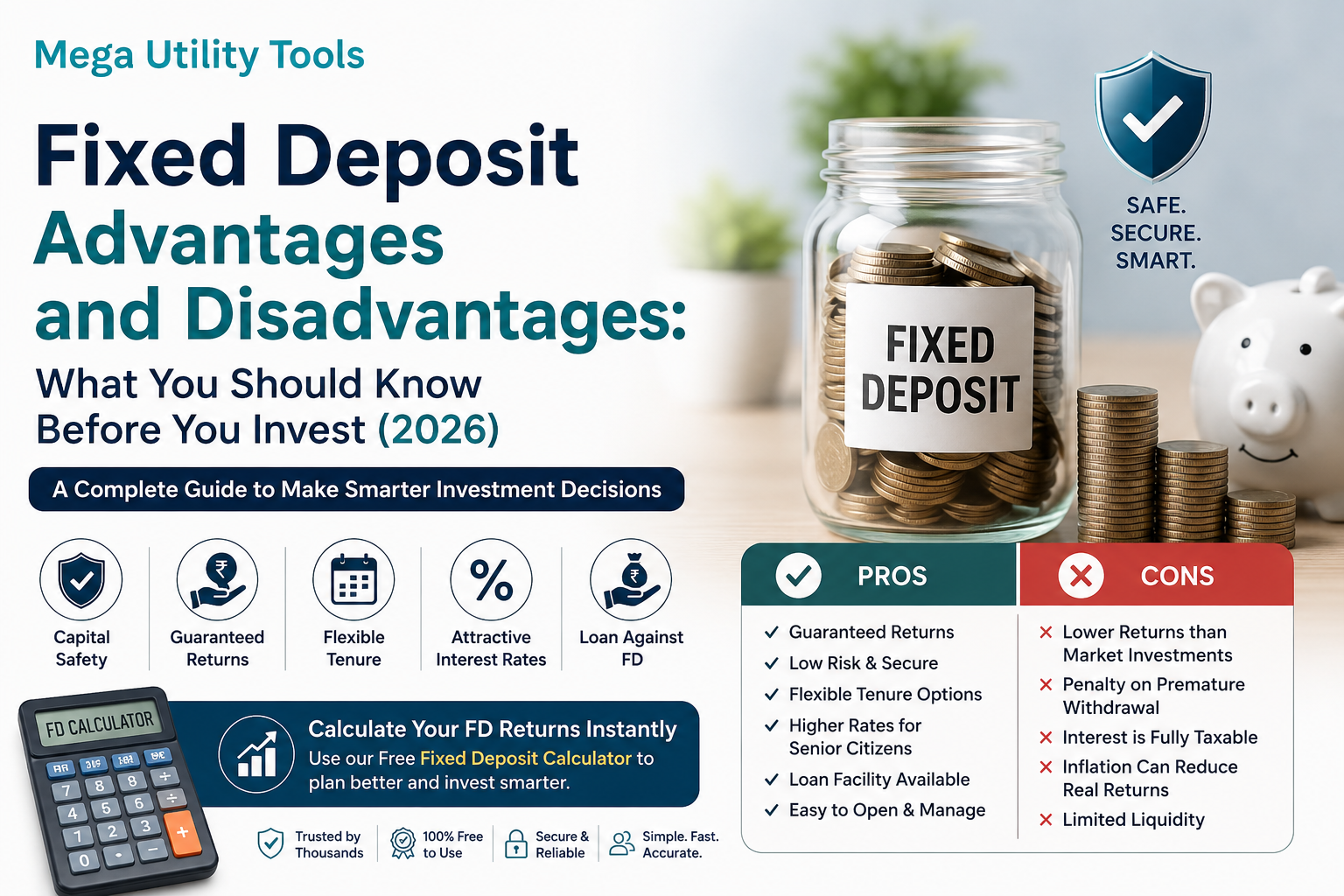
1. Guaranteed, Fixed Returns
One of the biggest fixed deposit advantages is predictability. Once you invest, your interest rate doesn’t change for the entire tenure, regardless of market fluctuations. You know exactly how much you’ll receive at maturity, which makes financial planning much easier.
2. Capital Safety and Low Risk
Unlike market-linked instruments, FDs aren’t affected by stock market volatility. Your principal amount remains protected, making it a preferred option for conservative investors who prioritize safety over high returns.
3. Flexible Tenure Options
FDs offer a wide range of tenures, typically from 7 days to 10 years. This flexibility allows you to align your investment with short-term or long-term financial goals, whether it’s an emergency fund or a long-term savings plan.
4. Higher Interest Rates for Senior Citizens
Most banks offer additional interest — usually 0.25% to 0.75% higher — to senior citizens. This makes FDs an attractive option for retirees looking for stable, regular income without taking on investment risk.
5. Loan or Overdraft Facility Against FD
Many banks allow you to take a loan or overdraft against your FD, usually up to 90% of the deposit value. This gives you access to funds during emergencies without having to break your deposit and lose out on interest.
6. Simple to Open, No Market Tracking Needed
Opening an FD takes just a few minutes through net banking or a mobile app. There’s no need to monitor markets, study company performance, or manage a portfolio, making it ideal for first-time investors or those who prefer a hands-off approach.
Disadvantages of Fixed Deposit
Now let’s look at the other side, because understanding the disadvantages of fixed deposit investments is just as important before you commit your savings.
1. Lower Returns Compared to Market-Linked Investments
This is the most commonly cited among fd disadvantages. FD interest rates, while stable, are generally lower than the potential returns from equity mutual funds or other market-linked instruments over the long term. If wealth growth is your primary goal, an FD alone may not be enough.
2. Premature Withdrawal Penalty
If you need to withdraw your FD before maturity, most banks charge a penalty, typically 0.5% to 1% lower than the applicable rate. This reduces your effective returns and is one of the key fixed deposit drawbacks for investors who may need liquidity unexpectedly.
3. Interest Is Fully Taxable
Interest earned on FDs is added to your total income and taxed as per your income tax slab. Unlike some other instruments, there’s no special tax exemption on FD interest, which can significantly reduce your actual take-home returns, especially if you fall in a higher tax bracket.
4. Doesn’t Always Beat Inflation
Over the long term, FD returns may not keep pace with inflation. This means the real value of your money — its actual purchasing power — could grow slower than expected, which is a genuine concern for investors with long-term wealth goals.
5. Limited Liquidity During the Lock-In Period
Once your money is locked into an FD, accessing it before maturity isn’t always convenient. While premature withdrawal is possible, it comes at the cost of reduced interest, making FDs less flexible compared to other savings options for short-notice needs.
FD vs Other Investment Options
Here’s a quick comparison to help put these fd advantages and disadvantages into context alongside other common options:
| Feature | Fixed Deposit | Recurring Deposit | Mutual Fund | PPF |
| Risk Level | Low | Low | Moderate to High | Low |
| Returns | Fixed | Fixed | Market-linked | Fixed (Govt-backed) |
| Liquidity | Moderate (penalty on early exit) | Moderate | High | Low (long lock-in) |
| Tax Benefit | None (interest taxable) | None | Depends on fund type | Yes (Section 80C) |
| Ideal For | Short to medium-term safety | Regular monthly saving | Long-term wealth growth | Long-term, tax-saving |
If you’re specifically weighing FDs against mutual funds, our detailed FD vs Mutual Fund comparison breaks this down further. And if you prefer saving smaller amounts monthly instead of a lump sum, a Recurring Deposit Calculator might be more suitable for your situation.
Who Should (and Shouldn’t) Choose FD
FDs tend to work well for:
- Conservative investors who prioritize capital safety
- Retirees seeking predictable, regular income
- Anyone parking short-term savings or an emergency fund
- Investors nearing a specific financial goal who can’t afford market risk
FDs may be less suitable for:
- Investors with long time horizons (10+ years) primarily focused on wealth creation
- Those in higher tax brackets, since FD interest is fully taxable
- Anyone who may need quick access to their full savings without penalty
If your goals include long-term, tax-efficient savings, it may also be worth exploring options like a Public Provident Fund Calculator, which offers different tax treatment and a longer investment horizon.
Calculate Your Expected FD Returns
The best way to decide if an FD fits your goals is to run the actual numbers. Enter your deposit amount, tenure, and interest rate into our Fixed Deposit Calculator to instantly see your estimated maturity value and total interest earned. This makes it easier to compare an FD against other options before you make a decision.
Conclusion
Fixed Deposits remain a solid choice for investors who value safety, predictability, and simplicity. At the same time, their lower returns, taxable interest, and limited liquidity mean they may not be the best fit for every financial goal, especially long-term wealth building.
Rather than viewing FDs as either “good” or “bad,” it’s more useful to see them as one tool among several. Understanding both the advantages and disadvantages helps you decide how much of your portfolio, if any, should go into fixed deposits based on your own goals, risk tolerance, and time horizon.
This article is for general informational purposes only and should not be considered personalized financial or investment advice. Please evaluate your own financial situation or consult a qualified financial advisor before making investment decisions.
Frequently Asked Questions
1. What are the main disadvantages of FD?
The main disadvantages of fixed deposit investments include lower returns compared to market-linked instruments, fully taxable interest income, penalties on premature withdrawal, and limited protection against inflation over the long term.
2. Are FD returns taxable?
Yes. Interest earned on a Fixed Deposit is added to your total taxable income and taxed according to your applicable income tax slab.
3. Is FD better than mutual funds?
It depends on your goals. FDs offer safety and fixed returns, while mutual funds carry market risk but have the potential for higher long-term growth. Many investors use both, depending on their risk appetite and time horizon.
4. What is the biggest advantage of FD?
The biggest advantage is predictability — you know your exact returns at the time of investment, along with capital safety, since FDs aren’t affected by market fluctuations.
5. Can I withdraw FD before maturity?
Yes, most banks allow premature withdrawal, but it usually comes with a reduced interest rate or penalty, which lowers your overall returns compared to holding the FD until maturity.