Saving money regularly is one of the simplest ways to build financial discipline and achieve future financial goals. Among the various savings options offered by banks, a Recurring Deposit has remained a popular choice for individuals who want to invest a fixed amount every month while earning interest on their savings.
However, one question that many investors ask before opening an RD account is:
“How is recurring deposit interest calculated?”
Understanding the interest calculation helps you estimate your maturity amount, compare different bank offers, and make better financial decisions. Fortunately, you don’t have to rely on manual calculations anymore. An RD calculator or online RD calculator can instantly estimate your returns, making financial planning much easier.
In this guide, we’ll explain how recurring deposit interest works, the formula used to calculate maturity value, and why using an online calculator can save both time and effort.
What Is a Recurring Deposit?
A Recurring Deposit is a savings scheme offered by banks and financial institutions where you deposit a fixed amount every month for a predetermined tenure.
Instead of investing a large amount at once, you gradually build your savings through regular monthly deposits. Each installment earns interest based on the applicable interest rate and the remaining investment period until maturity.
This makes recurring deposits ideal for:
- Salaried employees
- Students
- Young professionals
- Small business owners
- Anyone looking to build a disciplined savings habit
Since deposits are made monthly, the interest calculation differs slightly from a Fixed Deposit, where the entire amount is invested at one time.
How Does Recurring Deposit Interest Work?
Unlike a Fixed Deposit, where the entire investment starts earning interest from day one, every monthly installment in an RD begins earning interest only from the date it is deposited.
This means:
- The first monthly deposit earns interest for the longest duration.
- The second deposit earns interest for one month less.
- The last deposit earns interest only until the maturity date.
Because each installment has a different investment period, banks use a mathematical formula to determine the final maturity amount.
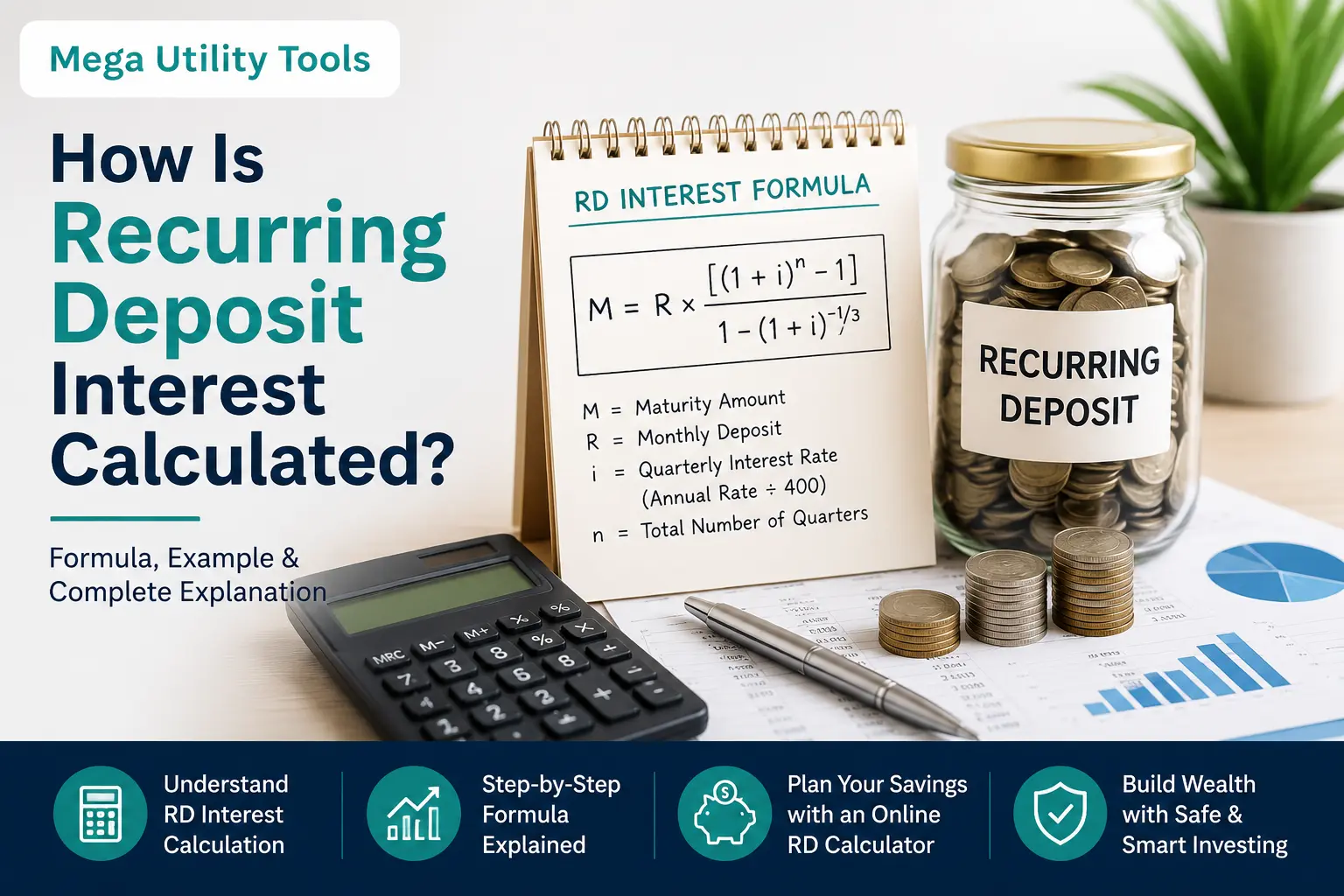
Formula for Recurring Deposit
Most banks calculate the maturity value of a recurring deposit using a standard compound interest formula.
Formula for Recurring Deposit
M = R × [(1 + i)^n − 1] ÷ [1 − (1 + i)^(-1/3)]
Where:
- M = Maturity Amount
- R = Monthly Deposit
- i = Quarterly Interest Rate (Annual Interest Rate ÷ 400)
- n = Total Number of Quarters
While the formula may appear complex, it ensures that each monthly deposit and its corresponding interest are accurately considered.
Instead of calculating it manually, most investors prefer using an online RD calculator, which provides instant and accurate estimates.
Example of Recurring Deposit Interest Calculation
Let’s understand the concept with a simple example.
Suppose you invest:
- Monthly Deposit: ₹5,000
- Investment Period: 5 Years
- Annual Interest Rate: 7%
Since every monthly installment earns interest for a different duration, the bank calculates the maturity value by applying the recurring deposit formula to all installments.
Rather than spending time performing complex calculations, you can simply enter these values into an RD calculator to instantly view:
- Total Investment
- Estimated Interest Earned
- Expected Maturity Amount
This makes financial planning faster and more convenient.
Factors That Affect Recurring Deposit Interest
Several factors influence how much interest you earn on your recurring deposit.
1. Monthly Deposit Amount
The higher your monthly contribution, the larger your final maturity amount is likely to be.
2. Interest Rate
Banks periodically revise their RD interest rates.
Even a small increase in interest rate can significantly improve long-term returns.
3. Investment Tenure
Longer investment periods generally allow more time for interest accumulation.
4. Compounding Frequency
Most banks compound RD interest quarterly.
Compounding enables previously earned interest to generate additional interest, increasing overall returns over time.
Why Use an Online RD Calculator?
Manual calculations are not only time-consuming but also increase the likelihood of errors.
An online RD calculator simplifies the process by providing accurate estimates within seconds.
Benefits of Using an Online RD Calculator
- Instant maturity calculation
- Accurate interest estimation
- Easy comparison of multiple investment scenarios
- Helps select the ideal investment tenure
- Supports better financial planning
- Saves time compared to manual calculations
Whether you’re investing ₹1,000 or ₹20,000 every month, an RD calculator makes planning straightforward and efficient.
Advantages of Investing in a Recurring Deposit
A recurring deposit offers several practical benefits for individuals looking for stable savings.
Encourages Regular Saving
Monthly deposits help build financial discipline.
Predictable Returns
Unlike market-linked investments, recurring deposits generally provide predictable returns based on the applicable interest rate.
Low Investment Barrier
Many banks allow investors to start with relatively small monthly contributions.
Suitable for Short- and Medium-Term Goals
Recurring deposits are commonly used for:
- Emergency savings
- Vacation planning
- Children’s education
- Wedding expenses
- Gadget purchases
- Home renovation
Common Mistakes Investors Should Avoid
Ignoring Interest Rate Comparisons
Different banks may offer different RD interest rates.
Comparing options before investing can help maximize returns.
Choosing the Wrong Tenure
Selecting an investment period that doesn’t align with your financial goals may reduce flexibility.
Missing Monthly Deposits
Regular contributions are essential for maintaining the benefits of a recurring deposit.
Not Using an RD Calculator
Many investors estimate returns manually, leading to unrealistic expectations.
Using an online RD calculator eliminates guesswork and provides reliable estimates.
Recurring Deposit vs Fixed Deposit
Although both investment options are offered by banks, they serve different purposes.
A Recurring Deposit is suitable for investors who want to save a fixed amount every month, while a Fixed Deposit is designed for individuals who already have a lump sum available for investment.
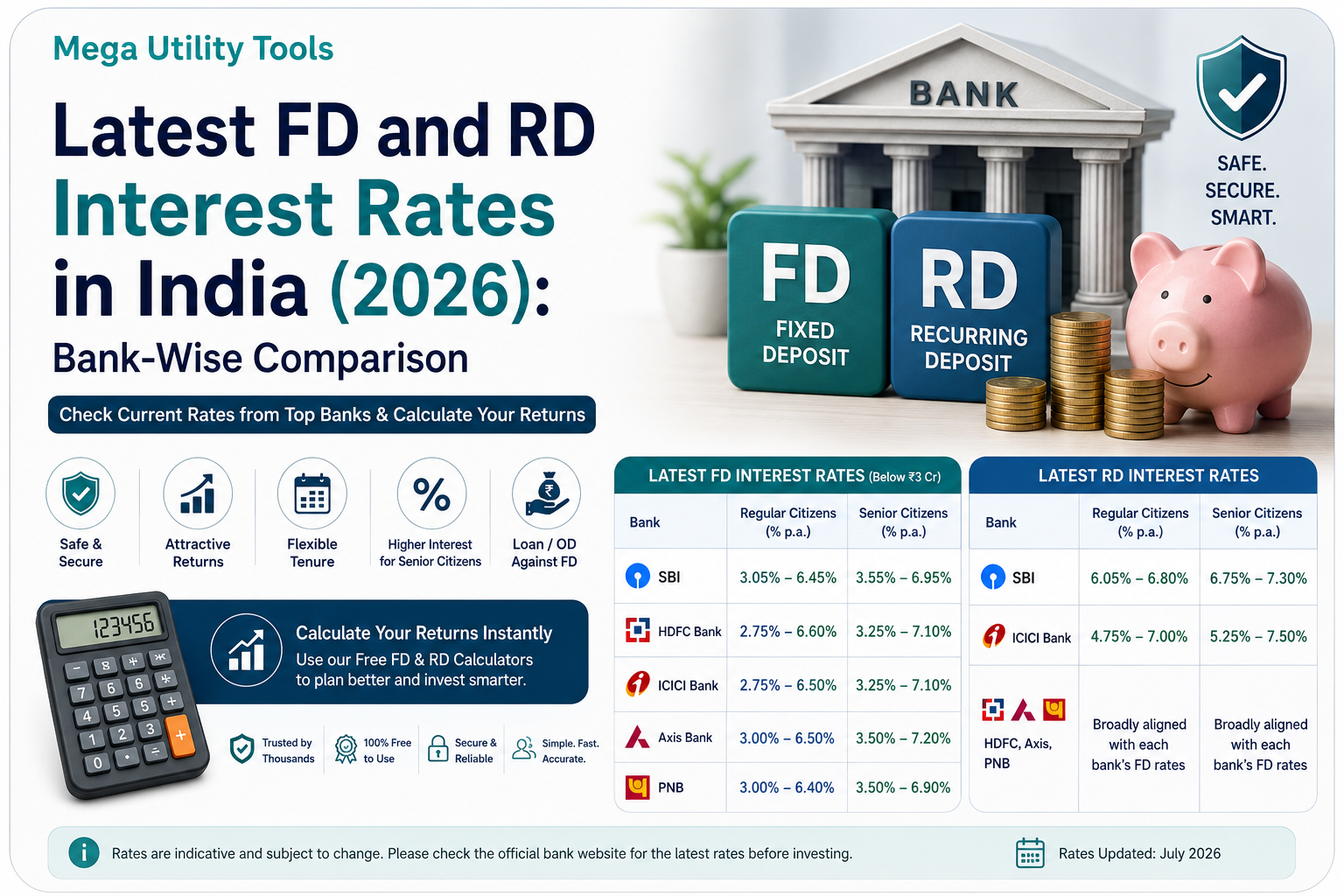
If you’re comparing both options, you can also use a Fixed Deposit Calculator to estimate maturity values and understand which investment better matches your financial goals.
Using both calculators helps investors compare returns before making a decision.
Who Should Consider a Recurring Deposit?
Recurring deposits are ideal for:
- First-time investors
- Students
- Salaried employees
- Freelancers
- Small business owners
- Individuals saving for short-term goals
The flexibility of monthly investments makes recurring deposits accessible to a wide range of investors.
Conclusion
Understanding how recurring deposit interest is calculated helps you make informed financial decisions and plan your savings more effectively. While the mathematical formula may appear complex, modern financial tools have made the process much easier.
Instead of performing manual calculations, using an RD calculator or online RD calculator allows you to estimate your maturity amount instantly, compare different investment scenarios, and select the option that best suits your financial goals.
Whether you’re saving for a future purchase, building an emergency fund, or developing better financial habits, a Recurring Deposit remains a reliable and disciplined savings option. Pairing it with tools like a Fixed Deposit Calculator can also help you compare savings strategies and choose the investment that aligns with your needs.
Frequently Asked Questions
1. How is recurring deposit interest calculated?
Recurring deposit interest is calculated using a compound interest formula that considers the monthly deposit amount, interest rate, compounding frequency, and investment tenure.
2. What is the formula for recurring deposit?
Banks generally use a compound interest-based formula to calculate the maturity amount, taking into account each monthly installment and the applicable interest rate.
3. Why should I use an online RD calculator?
An online RD calculator provides quick and accurate maturity estimates without requiring manual calculations.
4. Is a recurring deposit better than a savings account?
A recurring deposit is often preferred for disciplined monthly savings because it generally offers higher returns than a standard savings account, depending on prevailing rates.
5. Can I compare RD and FD returns?
Yes. You can use an RD calculator and a Fixed Deposit Calculator to compare estimated maturity values and determine which option better suits your financial goals.